In an article I read recently, I found out about a new film coming out, You Will Meet a Tall Dark Stranger, made by an artistic hero of mine by the name of Woody Allen. You might have heard of him. This film, like many of Allen's films, reflects the pure luck and circumstantial nature of life, which, from his viewpoint, is without meaning. In the interview, Allen reveals that life is survived by, simply, "distraction. And you can distract yourself in a million different ways, from turning on the television set and seeing who wins the meaningless soccer game, to going to the movies or listening to music." One of the characters in the film whose life's course gets altered by a distracting woman in the window across the street is Alfie; it is through his lens that we learn just how important "figures in the window" are to our survival of life. Allen purports that we fill in the gaps; we create what we don't know about the stranger in the window, day in and day out, to keep us interested, titillated, entertained. In the film, "Josh Brolin plays a writer, Roy, who becomes obsessed with the stranger in the window opposite. Does Allen think this is just the human condition? That we're all captivated by the stranger in the window?
"Yes, because you fill in the gaps. You see the woman in the window and you impute to that person the things you want to hear.""
That idea in itself struck me. The fact that such a nihilistic thinker like Allen came up with it is not what surprises me; it is, rather, the statement itself and its truth that have brought me to this blog post. I, myself experience this "stranger in the mirror" magnetization in regards to Allen: hooked by Allen's frequent directorial use of New York as a backdrop and of relationships' futility and insanity as a canonical device, I have created Woody Allen himself to be the neurotic, psychoanalytical, endlessly humorous little man that he portrays in film. In reality, however, Allen admits to being quite dedicated to certain arts (like film, jazz, and his clarinet) and therefore very regimented and average regarding his approach to life. This made me wonder: where can we find instances of the self-influenced "stranger in the window" in our own lives, and how and why do many of us construct such characters from reality? Allen would have us believe that we simply need to create non-mortal problems in life to continue on, things with which to distract us. But muses like unknown window figures can be much more than distractions; for some, they can become the object of artistic flourishment.
Let's take a portrait painter, for example. He or she sees an attractive individual across the street and begins to paint him/her, every day, as they go to and from the market to buy cucumbers. The artist will grow and grow and soon delineate from the original sketch or outward appearance of the individual. The artist's own personal talents have interjected, forcing themselves onto the the page and creating an entirely new individual in paint. Even better, however, is the fact that the process will teach the artist his/her faults. Such doting recreation highlights in brilliant clarity the mistakes and inconsistencies of an artist's technique; this is almost paradoxical in that a subject largely created or altered by the bias of the artist's fascinated mind can still be portrayed lamely and unfashionably. Sometimes, therefore, doting on the stranger in the window can do much more than distract us from the pain of life or even improve our creativity--it can also teach us about our own flaws and ways to improve how we look at the world, as long as we, the doters, steal a breath every once in a while from the sea of fascination.
What do you, the readers, think about the importance of the distractions we make for ourselves? Can devotion serve as a platform for self-improvement in your own lives? Do you feel as though the "Stranger in the Window" fascination of unknown individuals is a legitimate, common lens? If so, what foundations does it hold within your perception of life and entertainment?
Monday, March 14, 2011

Monday, March 7, 2011
New Historicism
In studying the various ways to read and interpret Hamlet, our class came across the approach called "New Historicism."
First, I just want to put it out there that I am so phenomenally thrilled with the fact that my education in History throughout high school has been largely taught through a new historicist lens. Hopefully you'll see why shortly.
The history that is told in old, stuffy, leather-bounds books regarding, for example, "The Boer Wars" (or any number of wars or events, really) is largely traditionalist. Although there may be accounts of life from some diverse cultures, those who do not "win out"--be it economically, militarily, or socially--certainly do not get to write their own narrative. What you see and hear comes from the lens of the victor. How he (more frequently than "she" in traditionalist history) views the world from his moment on the high horse is the best way, and the only way, to see (and rarely analyze) life. In addition--and, for me, this is the real kicker--Traditionalist history would deem that there are known, indisputable truths in this world. To me, such a statement, robbing existence of its infinite ability to surprise and robbing humanity of its endless lenses and lifestyles, is unendurable and misinformed.
An idea that arose in the 1980's and gained much steam in the coming decades, however, was that of New Historicism, in which every culture is influenced to some extent by another, removing the idea of purity; every criticism contains elements of what it criticizes; concrete, universal, 100 per cent fact does not exist; and that influence occurs as much from the bottom of society-up as it does from the top-down, to the extent that neither can exist without the influence of the other.
I personally love this point of view. I think it is essential to the growth of social equality on this planet. I personally recommend shows like Anthony Bourdain No Reservations (in English, on the Travel Channel) and Taxi 022 (in French), which are both programs centered around an individual's views and explorations of the world around them. The former, centered around how food, culture, and history intertwine across the world, helps us interpret the world more openly. The latter, consisting of the philosophical ramblings of a working-class, unintentionally farcical Montreal taxi driver with a fiercely opinionated world view helps us learn from example about how we should/should not approach the world from our limited, provincial perspectives.
One of the things I look for in a person is that he/she does not take his/herself too seriously. If they have a fault, they can see it, accept it, understand it to an extent, and roll with the punches. They are open to change and accept that they do not have all the answers, while still being undeterred from trying to find these answers to life's many questions. I find that New Historicism, much unlike the rigid, frequently Westward-biased traditionalist history, would be such a person if it had two arms, two legs, human features, speech, etc. New Historicism acknowledges that, although I write a blog, I can both have criticisms of blogs and can be amused by others' criticisms of blogs. For example, Rogatien's rant on blogs in the Taxi 022 posted here and above, although ignorant of blogs used to record and document profound personal discoveries, reveals what many people think about the what he calls (translated) "the internet: democratization of the moron" and about blogs in specific, in which "someone has a boring, crap day and then--on top of that--comes home and tells us about it!" I, myself, know that my blogs have their weak points like Rogatien points out. I ramble, I'm fascinated by too many things at once, and sometimes I post things that most readers won't understand! (That's called static noise interference, by the way. Go broadcasting class!)
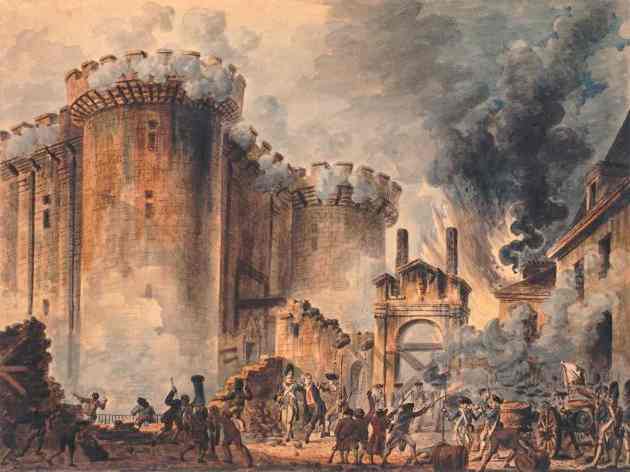
In any event, New Historicism is both at the forefront of the democratization of information (a new phenomenon) and the longtime evidence of power/influence of the people: see The French Revolution and Gandhi. What are your thoughts on how we interpret and transmit history? Am I blowing smoke? Is there really some truth that is easily identifiable for all people under all the eccentric mass that is Earth's inhabitants? Feel free to comment.
First, I just want to put it out there that I am so phenomenally thrilled with the fact that my education in History throughout high school has been largely taught through a new historicist lens. Hopefully you'll see why shortly.
The history that is told in old, stuffy, leather-bounds books regarding, for example, "The Boer Wars" (or any number of wars or events, really) is largely traditionalist. Although there may be accounts of life from some diverse cultures, those who do not "win out"--be it economically, militarily, or socially--certainly do not get to write their own narrative. What you see and hear comes from the lens of the victor. How he (more frequently than "she" in traditionalist history) views the world from his moment on the high horse is the best way, and the only way, to see (and rarely analyze) life. In addition--and, for me, this is the real kicker--Traditionalist history would deem that there are known, indisputable truths in this world. To me, such a statement, robbing existence of its infinite ability to surprise and robbing humanity of its endless lenses and lifestyles, is unendurable and misinformed.
An idea that arose in the 1980's and gained much steam in the coming decades, however, was that of New Historicism, in which every culture is influenced to some extent by another, removing the idea of purity; every criticism contains elements of what it criticizes; concrete, universal, 100 per cent fact does not exist; and that influence occurs as much from the bottom of society-up as it does from the top-down, to the extent that neither can exist without the influence of the other.
I personally love this point of view. I think it is essential to the growth of social equality on this planet. I personally recommend shows like Anthony Bourdain No Reservations (in English, on the Travel Channel) and Taxi 022 (in French), which are both programs centered around an individual's views and explorations of the world around them. The former, centered around how food, culture, and history intertwine across the world, helps us interpret the world more openly. The latter, consisting of the philosophical ramblings of a working-class, unintentionally farcical Montreal taxi driver with a fiercely opinionated world view helps us learn from example about how we should/should not approach the world from our limited, provincial perspectives.
One of the things I look for in a person is that he/she does not take his/herself too seriously. If they have a fault, they can see it, accept it, understand it to an extent, and roll with the punches. They are open to change and accept that they do not have all the answers, while still being undeterred from trying to find these answers to life's many questions. I find that New Historicism, much unlike the rigid, frequently Westward-biased traditionalist history, would be such a person if it had two arms, two legs, human features, speech, etc. New Historicism acknowledges that, although I write a blog, I can both have criticisms of blogs and can be amused by others' criticisms of blogs. For example, Rogatien's rant on blogs in the Taxi 022 posted here and above, although ignorant of blogs used to record and document profound personal discoveries, reveals what many people think about the what he calls (translated) "the internet: democratization of the moron" and about blogs in specific, in which "someone has a boring, crap day and then--on top of that--comes home and tells us about it!" I, myself, know that my blogs have their weak points like Rogatien points out. I ramble, I'm fascinated by too many things at once, and sometimes I post things that most readers won't understand! (That's called static noise interference, by the way. Go broadcasting class!)
In any event, New Historicism is both at the forefront of the democratization of information (a new phenomenon) and the longtime evidence of power/influence of the people: see The French Revolution and Gandhi. What are your thoughts on how we interpret and transmit history? Am I blowing smoke? Is there really some truth that is easily identifiable for all people under all the eccentric mass that is Earth's inhabitants? Feel free to comment.
Subscribe to:
Comments (Atom)